Found Poem
Free Verse
The Modern
Day Romeo and Juliet:
Embarrassed
To Talk About Love
"Even
asleep we partake in the becoming of the world.”
Endurance comes only from enduring.
With a flick of the wrist I fashioned an invisible rope,
And climbed it and it held me
two teenagers meet
at an ice cream factory,
through darting glances—
murmured hellos
before roll call
supervisors look away
and, finally, a phone number
folded up
is tossed discreetly
onto the workroom floor.
a shy smile
and then teenagers
being teenagers
out for an afternoon ride
suddenly, surrounded
screams and angry people
asking them "'What right did they have?"
What God-given right?
In the name of God
the police
rescue two teenagers
from a group of men
demanding
that they be hanged or stoned
In the name of God
A car bursts into flames
set by a crowd during the riot—
More clouds today than yesterday
One man dead many injured
a police station charred
as they demand justice
according to law
Both teens imprisoned
their fates in the hands
of an unsteady legal system
Arranged marriage
Counting the heads of goats
For the dowry
His father educated
Hers illiterate—
The oil in the lamp dwindling
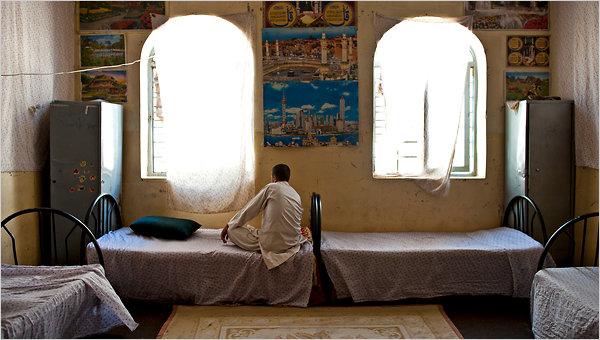
Rafi
Mohammed, 17, is held in a juvenile prison in Herat for
trying to run off with his girlfriend, Halima Mohammedi.
New York Times ~
Asia Pacific
Resources for
this Found Poem:
New York
Times article:
In Afghanistan, Rage at Young Lovers
Halima Mohammedi and Rafi Mohammed: Afghanistan's Romeo and
Juliet: Teenage couple jailed and face being stoned for
falling love - 1st Aug 2011
Czeslaw
Milosz, A Magic Mountain
"Even
asleep we partake in the becoming of the world.”
Endurance comes only from enduring.
With a flick of the wrist I fashioned an invisible rope,
And climbed it and it held me
Rafi Mohammed, 17, is held in a
juvenile prison in Herat for trying to run off with his
girlfriend, Halima Mohammedi.
By JACK HEALY: Published: July 30, 2011
HERAT, Afghanistan — The two
teenagers met inside an ice cream factory through darting
glances before roll call, murmured hellos as supervisors
looked away and, finally, a phone number folded up and
tossed discreetly onto the workroom floor.
~
~ ~
A version of this article
appeared in print on July 31, 2011, on page A1 of the New
York edition with the headline: Afghans.
Lynsey Addario for The New
York Times
Rafi Mohammed, 17, is held in a
juvenile prison in Herat for trying to run off with his
girlfriend, Halima Mohammedi.
By JACK HEALY: Published: July 30, 2011
HERAT, Afghanistan — The two teenagers met inside an ice
cream factory through darting glances before roll call,
murmured hellos as supervisors looked away and, finally, a
phone number folded up and tossed discreetly onto the
workroom floor.
~
~ ~
Lynsey Addario for The New
York Times
A car burned by a crowd during a
riot that took place after the police rescued two teenagers
from a group of men who had demanded that they be hanged or
stoned for their relationship.
It was the beginning of an Afghan love story that flouted
dominant traditions of arranged marriages and close family
scrutiny, a romance between two teenagers of different
ethnicities that tested a village’s tolerance for more
modern whims of the heart. The results were delivered with
brutal speed.
This month, a group of men spotted the couple riding
together in a car, yanked them into the road and began to
interrogate the boy and girl. Why were they together? What
right had they? An angry crowd of 300 surged around them,
calling them adulterers and demanding that they be stoned to
death or hanged.
When security forces swooped in and rescued the couple, the
mob’s anger exploded. They overwhelmed the local police, set
fire to cars and stormed a police station six miles from the
center of Herat, raising questions about the strength of law
in a corner of western Afghanistan and in one of the first
cities that has made the formal transition to Afghan-led
security.
The riot, which lasted for hours, ended with one man dead, a
police station charred and the two teenagers, Halima
Mohammedi and her boyfriend, Rafi Mohammed, confined to
juvenile prison. Officially, their fates lie in the hands of
an unsteady legal system. But they face harsher judgments of
family and community.
Ms. Mohammedi’s uncle visited her in jail to say she had
shamed the family, and promised that they would kill her
once she was released. Her father, an illiterate laborer who
works in Iran, sorrowfully concurred. He cried during two
visits to the jail, saying almost nothing to his
daughter. Blood, he said, was perhaps the only way out.
“What we would ask is that the government should kill both
of them,” said the father, Kher Mohammed.
The teenagers, embarrassed to talk about love, said plainly
that they were ready for death. But they were baffled by why
they should have to be killed.
Mr. Mohammed, who is 17, said: “I feel so bad. I just pray
that God gives this girl back to me. I’m ready to lose my
life. I just want her safe release.”
Ms. Mohammedi, who believes she is 17, said: “We are all
human. God created us from one dirt. Why can we not marry
each other, or love each other?”
The case has resonated in Herat, in part because it stirred
memories of a brutal stoning ordered by the Taliban last
summer in northern Afghanistan. A young couple in Kunduz was
stoned to death by scores of people—including family
members—after they eloped. The stoning marked a brutal
application of Shariah law, captured on a video recording
released online months later. Afghan officials promised to
investigate after an international outcry, but no one has
faced criminal charges.
The immediate response to the violence in Herat was
heartening by comparison. Top clerics declined to condemn
the couple. Police officers risked their lives to pull the
two teenagers to safety and deposit them into the legal
system, rather than the hands of angry relatives. And the
police reported that five or six girls had fled the city
with their boyfriends and fiancés in the weeks after the
riot.
After discussing the case, the provincial council decided
that Mr. Mohammed and Ms. Mohammedi deserved the
government’s protection because neither was engaged, and
because each said they wanted to get married. “They are not
criminals, even if they have committed sexual activities,”
said Abdul Zahir, the council’s leader. But so far, their
words have not freed either of the teenagers or lent
them any long-term security.
Ms. Mohammedi was initially taken to the only women’s
shelter in this province of more than 1.5 million people,
but the police transferred her quickly to the city’s
juvenile detention center, a sun-washed building where about
40 girls and 40 boys sleep in separate dormitories. The
police said they had referred the teenagers’ cases to
prosecutors.
Sharifullah Sahak and Lynsey
Addario contributed reporting. A version of this article
appeared in print on July 31, 2011, on page A1 of the New
York edition with the headline: Afghans Rage at Young
Lovers; A Father Says Kill Them Both.
~
~ ~
Marriage: Main articles:
Islamic marital jurisprudence, Talaq, and Nikah
The laws governing Islamic
marriage vary substantially between sects, schools, states
and cultures. The following outline is general in nature.
There are two types of marriage mentioned in the Qur'an:
nikah and nikah mut'ah. The first is more common; it
aims to be permanent, but can be terminated by the husband
in the talaq process, or by the wife seeking divorce using
khul'.
In nikah the couples inherit from each other. A dowry known
as mahr is given to the bride, a legal contract is signed
when entering the marriage, and the husband must pay for the
wife's expenses. For the contract to be valid there must be
two witnesses under Sunni jurisprudence. There is no witness
requirement for Shia contracts.
In Sunni jurisprudence, the contract is void if there is a
determined divorce date in the nikah, whereas, in Shia
jurisprudence, nikah contracts with determined divorce dates
are transformed into nikah mut'ah.
Under Shia jurisprudence, nikah mut'ah is the second form of
marriage. It is a fixed-term marriage, which is a marriage
with a preset duration, after which the marriage is
automatically dissolved. Traditionally the couple does not
inherit from each other, the man usually is not responsible
for the economic welfare of the woman, and she usually may
leave her home at her own discretion. Nikah mut'ah does not
count towards the maximum of four wives the
Quran allows to Muslim men. The woman is still given her
mahr dowry, and the woman must still observe the iddah, a
period of five months at the end of the marriage where she
is not permitted to remarry in the case she may have become
pregnant before the divorce took place. This maintains the
proper lineage of children. There is controversy about the
Islamic legality of this type of marriage since the Prophet
Muhammad is said by Sunnis to have prohibited the practice
after having temporarily allowed it.
A third type of marriage contract, known as misyar, is
emerging in Sunni Islam. This marriage is not
for a fixed period of time like nikah mut'ah, but is similar
in other respects including lack of inheritance, lack of
financial responsibility and freedom of movement on the part
of the wife. In misyar marriage, the couple need not
cohabit. There is also controversy regarding this form of
marriage.
Muslims do, on occasion, marry according to urf, or local
custom, without following the requirements set forth in
Sharia law. This may be done for various reasons, such as an
inability of the couple to obtain permission from the
bride's guardian. In these cases, they may find their
marriage to be unrecognized at a later point, and have
difficulty availing themselves of legal remedies under
Sharia.
Requirements for Islamic
Marriages:
The man who is not currently a fornicator may marry only a
woman who is not currently a fornicatress or a chaste woman
from the people of the Book. The woman who is not currently
a fornicatress may marry only a man who is not currently a
fornicator. The fornicator may marry only a fornicatress.
The Muslim woman may marry only a Muslim man. Permission for
a virgin female to marry must be given by her guardian,
usually her father. Any Muslim woman may demand her guardian
marry her to a Muslim male, provided he is suitable. If the
guardian refuses, a judge will effect the marriage.[93]
The father, or in some cases the paternal grandfather, may
choose a suitable partner for a virgin girl.[94]
The guardian may not marry the divorced woman or the widow
if she did not ask to be married.
It is obligatory for a man to give bride wealth (gifts) to
the woman he marries – "Do not marry unless you give your
wife something that is her right."[95]
[edit] Polygamy
In Sharia law, a Muslim man is
permitted up to four wives under the rules for nikah.
All wives are entitled to separate living quarters at
the behest of the husband and if possible. All should
receive equal attention, support, treatment and inheritance.
In modern practice, it is uncommon for a Muslim man to have
more than one wife; if he does so, it is often due to the
infertility of his first wife. The practice of
polygamy has been regulated or abolished in some Muslim
states.[96][97]
Historically, Muslim rulers have often remarried the wives
of their conquered opponents in order to gain ties of
kinship with their new subjects. In these cases, the wives
of leaders have sometimes numbered in the tens or even
hundreds. In Ottoman Turkey, the practice also filtered down
to the aristocracy. This became the basis for the Western
image of a powerful, wealthy Muslim with a vast harem.[98]

