
Contributing
Editor, Helen Bar-Lev, IL
|
|
Interview
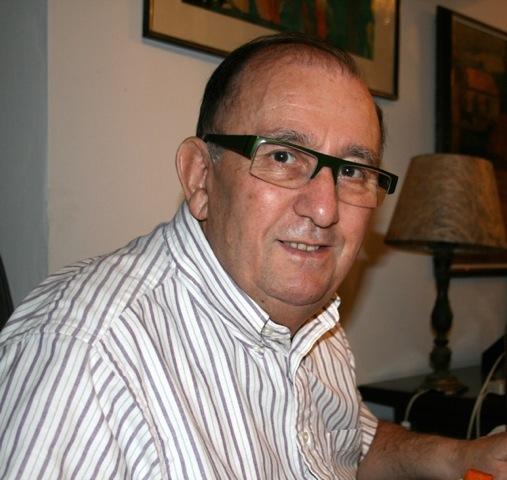
with Michael Stone, IL
Question: What is your profession?
I am retired and spend my time mainly on writing and
research. All my life I taught at the Hebrew University
of Jerusalem in Ancient Jewish Thought and Literature
and also Armenian Studies. I have an extensive list of
academic publications and, most important, have educated
some good scholars.
Question:
In which country were you born?
England: I grew up in Australia.
Question: How long have you lived in Israel?
Since 1960,
with some years away on sabbatical leave.
Question: When did you begin to write poetry and what
prompted you to write?
I began to write (my adult writing – of course I wrote a
bit as a teenager) in 1999. I was staying with an old
friend, the Armenian Patriarch of Turkey, in the
Patriarchate in Istanbul, en route to Armenia. The
earthquake hit about 2 am. It was an extraordinary
experience; and it shook me out of a sort of aesthetic
somnolence. I went on to Armenia with my son, Dan. We
toured to a number of places, some new to me and some
well-known. I had to record my responses to them which
were exceptionally powerful. I did so in prose. After
writing several pieces of descriptive prose, I suddenly
realised that it was rhythmic and actually fell well
into the patterns of blank verse. Eventually, after much
internal agonizing, I sent them to Leo Hamalian, editor
then of Ararat, in New York. Leo, whom I had met once
before and always solicited me for articles, accepted
them and encouraged. He was a prince of a man who died
some years later and Ararat has never been the same.
Question: How long have you been a member of Voices?
I don’t rightly remember: about a decade.
Question: Do you belong to any other writing/poetry
groups? Please tell us a little about them.
IAWE which is a sub-category of the Israel writer’s
union. I belong, often publish in their anthology, but
only rarely attend events.
Question: What are the most important changes you’ve
seen in Voices in all this time?
Up to the last year or so, when I have attended only
sporadically, the Jerusalem group was made up of older
poets, with a few younger ones to spice the mixture.
Some remarkable people, with English as second or third
language. Now, in my latest visits, I feel a changing of
the guards and some new poets, younger, have attended.
It is, in my view, a quite extraordinary group.
Question: What inspires your poetry?
I wish I knew -- seeing, life, feeling, mainly
consciousness. In specifics, for me-- self and its
struggle for adulthood and things that help me configure
myself; Jerusalem and Israel and being here and the
land; subjects to which I give much scholarly energy,
which carry great associations, such as manuscripts,
Armenia; interactions in teaching, frienship, love,
memory. I also love translating medieval Armenian
poetry into English.
Question: Which forms do you prefer?
Blank verse, often in non-rhyming quatrains, 4-6 feet,
alliteration and sometimes A:C or B:D rhyme.
Question: Why?
I am most comfortable with this sort of blank verse. I
have written some much more formal poetry, sonnets, etc.
but never feel mastery.
Question: Who is your favorite poet?
Hopkins in English; probably Frik in Armenian.
Question: Where have you been published?
Quite a lot of venues: some Armenian ones, mainly
Literary Groong, Armenian Poetry Project; a few
Jewish/Israel ones such as Deronda, Cyclamens and
Swords, Voices (I try to avoid “Grandmother’s gefilte
fish” venues and the Armenian equivalent “Grandmother’s
dolmas” venues); some general ezines and print magazines
such as SpeedPoets (from Queensland), Avocet,
BellowingArk.
Question: Where do you live?
I live in Jerusalem and have lived in the same house
since 1971. I see the Judean hills from the windows,
ridged by the stumps of terraces some of which are 2,000
years old. The room in which I work looks out on the
hills and the shadows of the forest change as it moves
across the sky. The sunsets, especially from spring to
autumn, obsess me.
Question: Tell us a little about your family?
My wife of 50 years is a historian of art and we like
one another a lot. I have two children, and at present,
four grandchildren, more coming, I am told. My parents
grew up in the ghetto in Leeds, my birthplace. Large,
working class families, many cousins most of whom I know
only superficially because my family emigrated to
Australia. I have been fortunate in my life and friends
Free
Verse
The New
Pond
ducks, geese and rushes,
a swan parceled
up
head wrapped in wing
ducks root in
mud, and geese
splash-land on the water.
on a post, a duck
sits like a effigy
watching
the goose squadrons
swim in
regatta.
willows’ long leaf-hair
combs the shining surface
and green algae
scum reflects
the shopping centre wall.
in Sinai’s wilderness
millennial
marks record
an ancient nomad’s passing.
Norway’s virgin forest,
first and
pines and snow,
is primal, untouched,
pathless.
but here by the new pond
trees are planted,
rushes trained
upright,
paths swept, grass mowed,
edges neatly clipped,
fallen leaves
daily blown away,
and never crackle under
food.
North Carolina, 2006
Previously published in Avocet
winter 2010
A
Notebook
The famous
paperless office isn’t, and stationery shops have become
mini computer stores with a few school notebooks and
crayons. Apologies for what they once were.
I
wanted a good notebook
to write in with my
fountain pen,
without the ink bleeding
through
and ghosting on the other side
or staining paper veins around letters.
Not
for ballpoint or roller ball,
or gel or felt
or any other such,
but for a pen, ink and
gold nib.
One of writing’s pleasures,
a
once modern replacement
for an iron nib and
an inkwell.
I
found a foolscap, graph-ruled,
black-boarded
note book. The only one
with polished paper
for writing,
for writing over and under and
polishing.
for crossing out, writing above
and correcting.
It
had black covers and a spiral,
not bound.
But that’s
a small concession to make for
paper and pen and nib,
and ink that does
not bleed,
through one side of life to
another.
Previously published in Speed Poets
April 2010
Green
Stones
Riding in an old dark forest,
On a
deer-path scarcely seen,
Where vines like
mossy ropes,
Brush the young man's head.
Circles cut into great trees
Mark out
his way within,
To a shadowed, hidden
place,
On a path now seen, now hidden.
Guided by damp green stones
By runes
cut in ages past,
Piercing the forest's
heart,
Beyond where men's paths lead.
Quiet respite flows forth,
The rider
senses its stream,
No birds call out in
there,
The heart is silent, serene.
i
do not know about God
i do not know about God,
i cannot say
"you" to Him as
One I address directly.
such providential
realism is not
mine.
liturgy, though,
has its own
rhythm.
familiar service,
words soothe
the soul.
suddenly, meaning strikes
home,
pierces the heart!
let the
pattern of words then,
known, loved,
carry us and,
if we are lucky,
every
now and then
focus in a different way,
sharp, impelling, shock.
30 April,
2010
Whiskers
Shaving, whiskers growing with grey,
look carefully at face, do not nick.
When else do we stop, look at our face,
our hands, ourselves, for
eyes are
windows of the soul.
Is the soul mottled
like my whiskers?
When the kids were
little
I scratched them with my
whiskers,
black they were then.
Soap and brush and lather,
lathered with
sweat,
heave, heavy, heave-ho,
up
goes the topsail.
the drunken sailor.
After all why shave with a safety blade,
or a straightedge stropped on leather
when the electric is so easy?
But you
don’t need a mirror.
shaving, wood shavings from
planing
Canadian pine
curl up in tight
pine-scented rolls
drop to the floor
arm, shoulder, torso move
the plane over
the wood.
Smooth, fluid movement
shaving whiskers,
old ways,
up the topsail, planing pine
by hand,
shaven and showered.
Previously published in Speed Poets.
from Selected Poems
Locked Gates
Still, chill air in the street
empty early
morning bare
high walls, closed gates
flash and unlock so
key-holders may enter
into the palaces. door-keepers
guardians
keys passwords,
open and permit ascent
upwards inwards through
door within doors to
the palace
within palaces
that eye
rejoices
which alone can read
the key to
place in the lock
the word, the pass code
to open locked gates
in the palaces'
heart
the throne room flashes
fiery rivers
and crystal.
He is there and not there
and not just there
for ever now.
Birds of Paradise*
The
parchment lampshade glows warmly,
adorned
with a peacock that
preens proudly between
two fruit trees,
like in the Garden.
Its angles'-eye tail curves down,
Paradise
bird, immortality's symbnol.
Cherubs' wings
are full of eyes,
God's eyes range all the
earth.
The vine meanders through the
mosaic,
tracing medallions, embracing
birds in its grape-weighed branches,
with
pomegranates--Eden's fruit.
At the vine's
stock a bird in a cage,
its wings flutter in
the body's prison,
two peacock tails frame
its base,
eying the blind soul's struggle.
Will the soul bird learn it's caged:
Will
the soul bird break free?
soar, wing up
through the spheres
and byond the heavens?
*Inspired by the Bird Mosaic in
Jerusalem
Prayer
How
does an unbeliever pray?
Yet I do.
Some know God
in halogen-bright blinding
white light
with black, black shadows.
But
I see grey.
'Glory to God for dappled
things',
for unclarities ambiguities
complexities all,
for greys.
He will
be one with His name:
God's wholeness then.
But ours?

|
|