
Contributing
Editor ~ Helen Bar-Lev, IL
|
Interview
With Judy Labensohn, IL
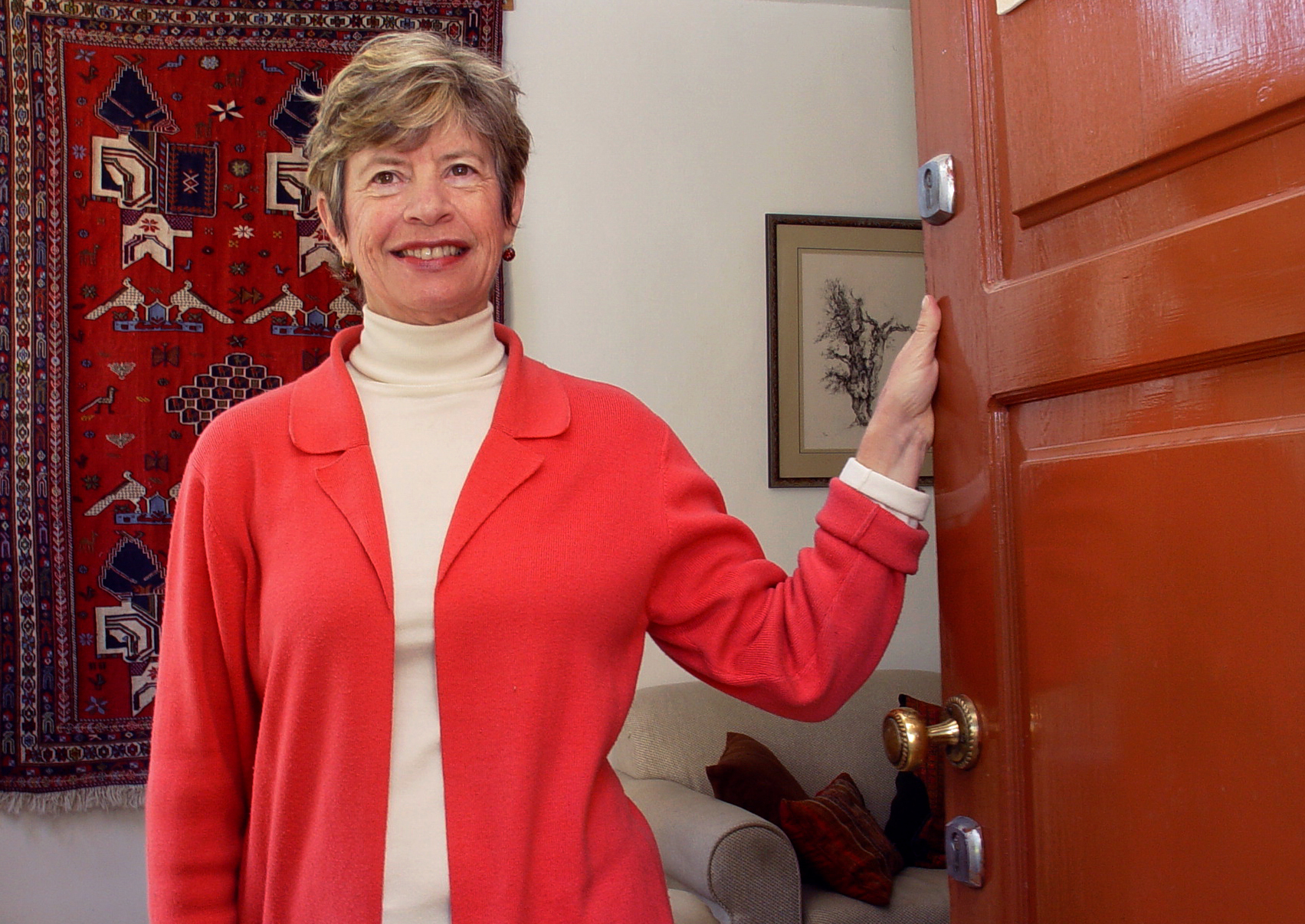
Q. WHERE WERE
YOU BORN?
A. I was born in the United States.
Q. HOW LONG HAVE YOU BEEN IN ISRAEL?
A. I first came to Israel in 1966 during the summer between
my junior and senior year at the University of Michigan to
collect chicken eggs at Kibbutz Ginosar. I fell in love with
the Kinneret and wanted to quit school, but I was afraid of
my father, so completed my BA in American Culture. I planned
to return to Israel for a year of study within the framework
of the Hebrew University One-Year Program, but the Six Days
War broke out. May ’67 was an anxious month. If Israel had
lost the war, I would have gone to Johns Hopkins for a PhD
in American history. Fortunately, Israel won and I’ve been
in Israel since August 1, 1967.
Q. WHAT IS YOUR PROFESSION?
A. I prefer to relate to jobs rather than “profession.” I
served as the first English secretary to Ruth Cheshin at the
Jerusalem Foundation in 1968. In that position I learned how
to write good letters to Lord Rothschild and Isaiah Berlin.
But I sought more out of life, so earned a Bachelor of
Social Work degree in a one-year retraining course for new
immigrants at Hebrew University School of Social Work. I
became a psychiatric social worker at a Jerusalem mental
health clinic. But I never stayed in one job for more than
seven years. Shpilkes is the word my grandmother would have
used to describe me. Once I mastered something, I moved on.
The next job was motherhood. It didn’t pay very well and I
never actually mastered it in real time, though now I am
quite good with two-year olds. I translated, wrote a
personal essay column, worked as a community worker in a
Reform synagogue, created life cycle events at Neot Kedumim,
the Biblical Landscape Reserve near Modi’in and then decided
to study writing, which I had been doing all along anyway. I
earned an MFA in creative nonfiction in a low-residency
program at Goucher College and then an MA in fiction at Bar-Ilan
University. Now I administer the program at Bar-Ilan, The
Shaindy Rudoff Graduate Program in Creative Writing, and
teach creative writing elsewhere. I suppose this makes me an
administrator and a teacher, professions for which I have no
formal training. Jean Kadmon was the first and only person
who told me I was a poet. That was in 1973.
Q. HOW LONG HAVE YOU BEEN WRITING POETRY?
A. Arbor Day in
1954 prompted me to write my first poem. Red Cross Day
prompted the second. I had a good ear for rhythm and abab
rhyme schemes. Miss Neustadt, my third grade teacher,
appreciated my efforts and hung my poems on the bulletin
board in the hall. A poem hung in the hall goes a long way
for a child with no self-esteem, or whatever they called
what I didn’t have back then. In the sixth grade I wrote the
class graduation song to the tune of “Jingle Jangle” and in
seventh grade I wrote the junior high pep song. I didn’t
like to read books, but I did like to read short poems that
rhymed and I loved The Lucky Strike Hit Parade on American
TV in the 1950’s. Nobody, except the school librarian and
maybe my nursery school teacher, read me a book. I was more
of a dreamer than a reader.
So, I went from two poems to two songs to a few dry years
and then “thoughts” in a cheap plastic notebook at fifteen.
What prompted my poems in adolescence were clouds,
loneliness and homework assignments. I loved Anne Bradstreet
and Emily Dickinson, but was afraid to even want to be a
poet because women poets were lonely, unmarried, crazy and
suicidal. Also, “poet” was not an option at the high school
Career Day. I wrote many poems in college and in my
twenties, less in my thirties and forties, a few in my
fifties and sixties. I do not call myself a poet, though
poetry was my first love, as it enabled me to express what I
could not express in any other way. It kept a channel open
to my inner swamp. My most famous poem, “Applelore” was
inspired by Paradise Lost when I was twenty.
Q. DO YOU BELONG TO ANY WRITING GROUPS?
A. I never belonged to a writing group. I always wrote on my
own and never asked anyone for help. I do not recommend this
and I have great admiration for people who ask others for
feedback and find good mentors. I wish I had been wise
enough to find a mentor when I was an isolated writer in
Jerusalem. I think some of my motivation to teach writing is
to give to others what I couldn’t find for myself. (Once in
the 1970’s a woman whose name escapes me gave a one-time
three-hour writing class at Beit Agron. I took that. Once in
the 1980’s a graduate from the Iowa MFA Program taught at
Hebrew U. for a semester. I took that. Once in the 1990’s I
went to Wales for a week of workshop with Elaine Feinstein.
Heaven on Earth.) I loved to read “how to write” books,
which made me realize I was interested in pedagogy as well
as writing. Today, teaching and mentoring give me either
more or as much pleasure as writing. When I teach I love
seeing writers’ stories and essays develop from one draft to
the next until they win a contest. I’m a good reader and I
always encourage the writers in my groups to go deeper,
focus, dare and cut. I get excited by the good writing my
students produce. Their success is my success.
Q. WHAT INSPIRES YOUR POETRY?
A. What inspires
my poetry is reading good poems by people who have studied
the craft and know what they are doing.
Q. WHICH FORM DO YOU PREFER?
A. I used to need strict structure in terms of rhyme scheme
and rhythm, but now I need free verse.
Q. FAVOURITE POETS?
A. In high school I loved Robert Frost, Emily Dickinson,
Edna St. Vincent Millay, and Walt Whitman. Later I loved W.B.
Yeats, Dylan Thomas and Wallace Stevens. I liked Psalms and
Proverbs, Adrienne Rich, May Swenson, Rilke. Today I have no
favorite poet. I have always liked popular music.
Q. WHERE HAVE YOU BEEN PUBLISHED?
A. After the bulletin board at Ludlow School my poems
appeared in Generation (U. of Michigan),
Analecta, Response, Pudding, Shdemot, Conservative Judaism,
Forum, Arc, More of Our Lives, and All of Our Lives.
“Applelore” was anthologized in a college reader called
Headway: A Thematic Reader in 1970, unbeknownst
to me until a friend in Detroit who teaches English sent me
a copy. It appears on the same page with Thomas Merton and
Robert Herrick. My claim to fame.
Q. WHERE DO YOU LIVE?
A. For the past six years I have lived .7 kilometers outside
Jerusalem in Moshav Beit Zayit. Leaving Jerusalem after
thirty-eight years was so traumatic I wrote a story
collection called Bethlehem Road. I still love
Bak’a, the neighborhood where I lived, like I used to love
the Kinneret, but I can live without them.
It took me many years to realize what an enormous loss is
involved in making aliyah. Nobody talks about this loss
because we all have a little man from the Jewish Agency
sitting on our shoulder telling us to keep quiet. But once
we shake him off we realize the enormity of the loss of
language, family, context, libraries, bookstores and
readers. We live in exile from our mother tongue. The
sweetness in this exile is to luxuriate in the center of our
history, at home with our people. Yet, the loss is palpable,
especially when one looks back and answers questions such as
these on the Sketchbook Questionnaire.
Poems of
Judy Labensohn, IL
Veteran
My downstairs
neighbor ceded an eye
for the State. Each month he gets a check.
Lately, his wife's been asking for whiskey,
then telling stories. He's not pleased.
After a scotch on the rocks, 1948
loses its glory, becomes a maze of sad mistakes.
She says his glass eye hurts
so he stays in bed all day
but can't sleep.
Blood pressure surges
to shrapnel locked in his head–
black seeds that make
rooms explode.
He tries to digest what crashed then,
each scrap remembered
half through bloodshot
half through glass.
Grandma
I leapt over
mother
to dwell in you: smudged apron,
lonely old Jew, playing gin rummy
with a nine-year-old girl on Saturday nights.
We made a couple: I knew the language,
you read time; I kissed the boys,
you watched from behind twisted
columns in the dining room
like a witch. Later we played Fish 'till
I won and forgot we were the only
ones home, left behind with
the panicked fish in their bowl.
Today, my arms flap like blintzes,
my corns hurt (Storm coming). I sit at windows
and watch. Your Atlantic crossing
I uncrossed to dwell in our roots.
Grandma, wait for me at the screen door
in your blue apron and the smell of
stuffed peppers. I'll bring curlers and your quilt
stitched with those purple ducks
tattered, yet still trying
to break out of the frame.
House Call
On the first day
of National Brotherhood Week
1951, the rabbi came to the house
to say
Your baby brother died.
It was quote a great time
to think of helping men toward
a firmer bond of brotherhood.
unquote
Snow melted from the rabbi's galoshes
into the carpet. His wool scarf
and fur hat lifted like dead
weight to expose a bald head.
Above the sofa
where He sat hung an Iowa farm
so a halo of corn hair
sprung from His head.
When He said Your baby brother
died, I believed.
God would not lie
on a house call.
He holds my hands. His hands—
Ivory Snow. I keep
these divine hands in mine,
but He has things
to do.
Repeat after me
He says and chants
Psalm 23.
Oil drips
from somebody's head.
He rises, puts
on His black boots
black scarf and hat
says Good-bye.
Daddy says Stop!
when I start to cry.
My thumb
stuck
in the valley of the shadow
of death forever.
Next day
Grandma moved in.
We never visited my brother's
grave because there wasn't
which was OK considering
the weather.
Berkowitz-Kumin did the cremation
but it doesn’t matter when you’re five
years seven months and
thirteen days old.
Due to advances in the 1940's and '50's
ours was a model American home: The maid mangled.
TV silenced the living room. Nylons
covered Mommy’s legs. (We wore
Mother/Daughter Dresses
so no one
could tell us
apart.)
Daddy bowled. Mommy became Pres.
of the PTA. We celebrated
Fourth of July and one Thanksgiving
before the pie
a new brother
sang “God
Bless
America.”
It takes sixty years
to grasp
who died that day.
Among the dead one stood
in the kitchen
when America marked quote
February!...
the month filled with great dates
and names…the month of which we hear the praises
sung to George and Abe and Tom;
to the four chaplains who chanted prayers
in different tongues
as they plunged beneath the waves
on the fighting Dorchester…
unquote
Her apron froze
at the stainless sink,
hands reaching only
for soap.
Oh, she could say
Pass the butter, please
but when in 1963
she finally cried
(not for the vegetable
boy
buried inside
me)
but the green felt
feathered hat
consumed by flames
at the neighborhood beauty shop.
Write In Israel is
the website of writer, teacher and mentor Judy Labensohn.
Judy Labensohn,
Coordinator
Shaindy Rudoff Graduate Program
in Creative Writing at Bar-Ilan University
http://english.biu.ac.il/creative-writing
Facebook:
http://www.facebook.com/profile.php?id=1471764703&ref=ts
Blog:
http://writingfromisrael.blogspot.com/

|
|