
Contributing
Editor, Helen Bar-Lev, IL
|
Interview
with Gilbert Herbert
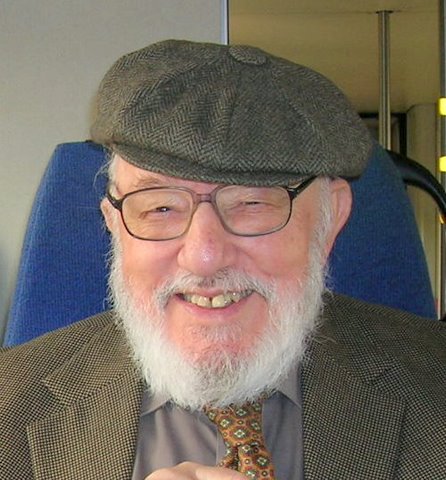
Question: Where do you live? Tell us a little about your
family?
Valerie, my wife of fifty-eight years, and I live on Mount
Carmel in Haifa, in an apartment looking out over forest,
mountain and sea. Our daughter Margalit and husband Itzik
also live in Haifa. We have three grandchildren: the oldest,
Shani, presently lives in Tel Aviv, and studies anthropology
at Bar Ilan University; Avri, post army, post South America
back-packing, lives in Haifa, and is studying to be an
Israeli tour-guide; and Maor, the youngest, after a year at
a kibbutz in the framework of Nachal (an agricultural unit),
has just gone into the army.
Question: What is your profession?
I
am an architect, architectural historian, and academic,
Professor Emeritus and former Dean of the Faculty of
Architecture and Town Planning at the Technion: Israel
Institute of Technology, and founder and past head of its
Architectural Heritage Research Centre.
Question: In which country were you born?
I was born in 1924 in Johannesburg, South Africa, and raised
and educated in that city. My parents were born in England
and Ireland, my grandparents in Lithuania and Latvia.
Question: How long have you lived
in Israel?
We left South Africa in 1961, and first moved to Adelaide,
South Australia, where I held a senior academic position for
seven years. In other words, we went on yerida (leaving
Israel) before we came on aliyah (coming to Israel). My wife
and I, our late son Barry – who had just celebrated his
barmitzvah - and young daughter, settled in Israel in August
1968.
Question: When did you begin to write poetry and what
prompted you to write?
I was fortunate to have an excellent English teacher at High
School, who instilled in me a passion for literature, and
encouraged me to write poems for the school magazine. These,
my first poems, all odes - alas, I no longer have them -
were published about 1939–1941. I have a great love of the
English language, and enjoy writing in all its forms,
ranging from our annual family news letter, chronicles of
our family history, discourses on politics, to serious books
on architectural history. Poetry is just one facet, and not
necessarily the most important one.
Question: How long have you been a member of Voices?
About 30 years, I think. I have a copy of Voices No. 4,
1976, but I don’t have a poem in it. My next is Volume 10,
1983, when my work appears, but I am no longer listed as a
new contributor. Extrapolating, I guess I joined about 1981.
Question: What are the most important changes you’ve seen
in Voices in all this time?
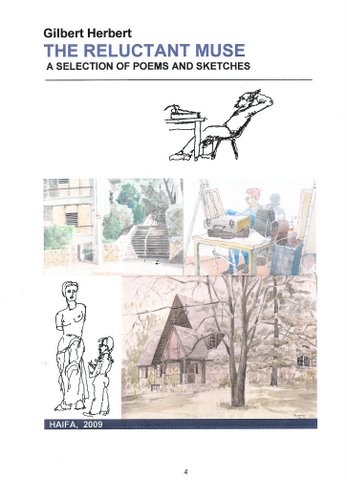
As a technical production it has become much more
professional. As a sounding board for the poet’s voice it
has become more inclusive. The innovation which gave me the
most pleasure was the inclusion of sketches with the poems
in the annual Anthology.
Question: What inspires your poetry?
A
mood, an odd juxtaposition of phrases, a sudden thought, a
funny thing which happened on the way to the computer. I’m
pretty eclectic in my choice of subject, but I am more
interested in people than in the minutiae of nature. Many of
my poems are introspective or biographical, and sometimes
reveal more of my inner being than I had intended – which I
suppose is part of the power of poetry.
Question: Which forms do you prefer? Why?
As time goes by, I have become more conservative, more
traditional. In painting my abstract period is over, and I
have returned to realism. In poetry, while I no longer write
odes, I do like a formal structure, and I occasionally enjoy
the discipline of finding an appropriate rhyme.
Question: Who is your favorite poet?
This is the desert island disc sort of question. Let’s say
favourite poets. Well, I started with the romantic poets,
Wordsworth, Shelley, Byron, Keats, and I haven’t left them.
I had a Masefield phase and a T. S. Eliot phase, but they
are less enduring. And of course, there is always Ogden
Nash, an endless source of delight.
Question: Where have you been published?
Apart from the school magazine (which doesn’t count) my very
first poem, written in 1947, was published in the
South African Architectural Record, and later
reprinted, without permission, in the Octagon, the
Journal of the American Institute of Architects. I
have not actively sought publication, except in Voices,
where I have been a regular contributor, and more recently
in Cyclamens and Swords. One of my poems
appears in the on-line journal of the International
Jewish Genealogical Society.
Question: Anything else you care to tell us?
For me, there is a whole universe out there, beyond poetry.
There is a world of love and affection, of family and
friends; my Jewish world, its faith, traditions and hopes,
its past and future; my academic world of learning and
teaching; my world of creating music, painting pictures,
designing buildings, writing stories; a sensory world of
sounds, scents, textures, colours; and a magical world of
mountain, forest and sea, and the ever-changing sky. This is
the world which constitutes my life, and this is my life
which informs and illuminates my poetry.
Free Verse
To a friend, on
the death of his daughter
1986
What can I say to you…
This is the way it is,
the loss so sudden
that there’s no pain
at first, only disbelief,
and a driving, futile
need to know, endlessly
asking what, and how.
Then anger comes, rage
against man, fate and god,
mostly against oneself,
guiltily the questions change
from what and how, to why.
There are no answers,
this is the way it is.
Anguish abides,
ache layered on ache,
boundless and corroding,
endless ebbing and swelling
tidal waves of pain.
There is no easing,
this is the way it is.
Turn towards tomorrow,
yesterday’s sorrow endemic,
survival the imperative, live
for those you love, now
infinitely precious.
Yet, memories remain,
this is the way it is.
Normality of a kind,
through a diminishing-glass,
not quite life-size,
some colours filtered out,
life’s music muted.
Nevertheless – laugh
you must, and love.
This is the way it is.
The Time Traveler
1991
My late mother, God rest her
soul,
was born more than a century ago,
in that momentous time in which
the first electricity power stations
went on stream.
She was as innocent of
science
as Thurber’s aunt who, so he wrote,
feared an empty light socket as
a source of electricity leaking out
upon her head.
My mother’s lifetime spanned
from this,
technology’s most tentative beginnings,
until the day when, sitting in her lounge,
she could enjoy her Beethoven and Brahms
in stereophonic sound.
She lived to see upon the TV
screen
(with eyes to which her failing sight
had been restored with laser beams)
the conquest of space, and men who walked
like gods upon the moon.
Within the seclusion of her
home
this quiet and unadventurous soul
calmly accepted the shockwaves of change,
and explored more new worlds than
Columbus dared to dream of.
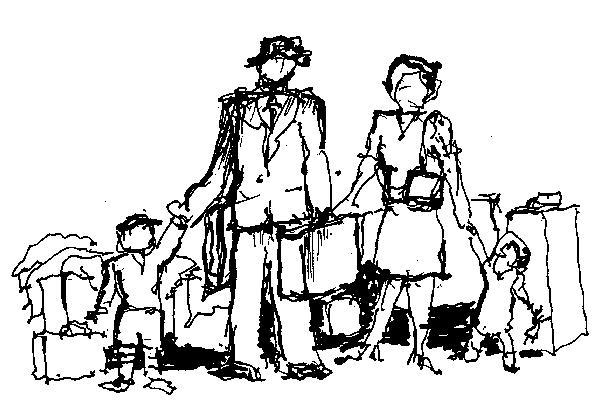
The emigrant
1994
In
Paris replanned
in Haussmann’s day,
trees full-grown
were uplifted from
the familiar earth,
and planted along
bold new avenues,
rich in promise
of abundant shade.
Here they struck
deep roots anew
flourished afresh,
green with leaf. |
To uproot
oneself
to shift the hearth
to foreign soil,
s transplantation
more painfully achieved.
One is a stranger
in a strange new land,
under alien skies,
not quite in exile,
not quite at home.
A good new life,
perhaps, but somehow
less than whole. |
Forest
requiem
1996
In the martyr’s forest
at the edge of the town,
on the path which leads
to the killing field,
all is tranquil now.
Birds sing their song,
and the insects hum,
and the tumbled twigs
soft-crackle underfoot
at Vilkomir
But on that black day,
when thousands marched
on the sun-dappled path
in the canopied woods,
with the sound of birds
and the insects’ hum,
was all tranquil then,
did not silence shout
its threat that day,
at Vilkomir?
Or did soldiers’ boots
and the lash of whips
and the baying dogs
and the children’s cries
drown out the birds,
still the murmuring quiet?
Was beauty masked
from fearful eyes
in the pain-filled forest
of Vilkomir?
When the shots rang out
the birds rose up
in frightened flight,
their fluttering wings
like fluttering hearts;
and the trembling leaves
fell as a shroud,
turned the forest floor
blood-red with shame,
at Vilkomir
A kind of immortality
2007
As the poet
said:
‘Now is the time for
the burning of the leaves.’
The leaves on oak and elm change
colour, wither,
release their grip on life, and flutter to the ground.
We who are in the late autumn of our lives
are sad witnesses to the human equivalent
of that natural process of decay and death.
With every passing month, or so it seems,
With ever growing frequency we are called
To yet another graveside of an old beloved friend,
as one by one they fall, like desiccated leaves,
from the tree of life.
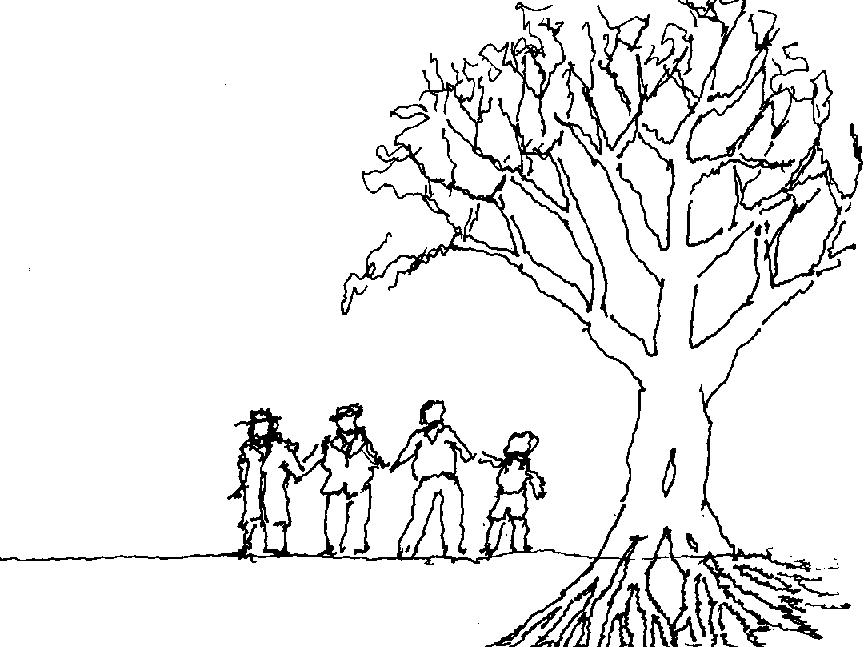
As the poet
said:
‘If
winter comes, can spring be far behind?’
Within seemingly dead trunks
life-giving sap arises,
from the structure of bare branches fresh growth appears
as sterile winter makes way for canopies of green.
In a wondrous way so it is with us, for
beyond the seeming terminality of the grave
our children, and then our children’s children
in the springtime and warm summer of their days
bind up our narrative with theirs, as they celebrate
the continuity of life.
Mind and matter
2009
I may not be schizophrenic
but I'm definitely in two minds
about the tally of my years.
When I think about the ‘me’
who lives inside my head,
that ‘me’ who still writes books,
solves
Times cryptic crosswords,
and enjoys the winter sunset,
a glass of Scotch in hand,
that ‘me’ who still appreciates
a bikinied girl,
and the sporty panache of an
XK Jaguar convertible,
then in my mind’s eye I’m still
a functioning, forward-looking
adult… maybe pushing forty.
But never mind the fortyish
‘me’ who lives inside my mind..
My treacherous mirror reveals
a much older person, stooped and grey,
baggy eyes and blotchy skin,
an unrelenting image which conspires
with trembling hands, unsteady legs,
erratic heart, shortness of breath,
and an ache in every joint.
Wait, young man, my body
says,
learn from me the true arithmetic
of time, those four score years
and more that have gone to fashion
the man you are.
Helen Bar-Lev,
artist, poet
www.helenbarlev.com
Senior Editor,
Cyclamens and Swords Publishing
www.cyclamensandswords.com
Secretary,
Voices Israel Group of Poets in English
www.voicesisrael.com
Contributing editor and global correspondent,
SKETCHBOOK, A Journal for Eastern and Western Short
Forms http://poetrywriting.org/
International Senior Poet Laureate, 2009
Amy Kitchener Foundation

|
|