Brian Strand, UK
Experimental
Poetry: Kuhlmann
Despair
From Night:
dark, black, dawns; the light
Opportunity
By Chance:
break, accident, fortune; will dance
Faith
In Truth: real,
wisdom, trust: hidden lies
A one line verse
poem in three parts with 2/3/2 words, totalling seven, with an
integral title.
The form is derived
from the sonnet 'Love-Kiss XLI' by Quirinus Kuhlmann (1651-89).
Note: The
monosyllabic three middle stem words (nouns) relate to the first
two words and describe them.
About
Quirinus Kuhlmann (1651-1689)
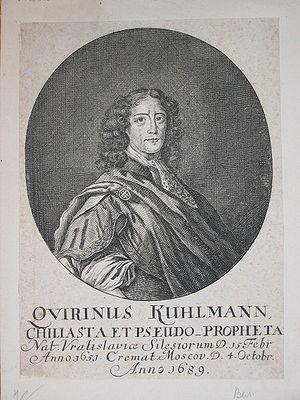
(Wikipedia)
Quirinus
Kuhlmann represents the culmination of various
important baroque traditions: mystical poetry, numerology,
and the attempt to rejuvenate the German language. Moving
back and forth among various groups of religious dissenters
in cities such as Leiden, Lübeck, London, Amsterdam, and
Paris, he regarded his life as "Ein Wunderwerk aller
Wunderwerke" (a miracle among all miracles) and envisioned
himself the new Messiah. Kuhlmann is chiefly remembered as
the author of a series of volumes of ecstatic lyrics in
which he pushed the expressiveness of German to its limits,
exploding its grammatical and semantic conventions (Dictionary
of Literary Biography on Quirinus Kuhlmann).
Quirinus
Kuhlmann, a poet and religious fanatic influenced by
J. Böhme, studied in Jena and Leyden, from which he was
expelled because of his revolutionary religious ideas. After
visiting England he went to Constantinople in order to
convert the Sultan (1678), returned to Holland, and finally
journeyed to Moscow to proclaim his idiosyncratic Kingdom of
God (‘Kühlmonarchie’); he was denounced as an enemy of
religion and the state, condemned, and burned at the stake.
He married three times in his short life...(Oxford
Companion to German Literature).
Quirinus
Kuhlmann was born in Breslau (Wrocław) in Silesia to
a Lutheran merchant, Quirinus Kuhlmann studied at the
Magdalena-Gymnasium with the help of a scholarship, as his
father had died when Kuhlmann was young (Wikipedia).
As a boy, Kuhlmann suffered from a speech impediment and was
often mocked for his condition. Some scholars believe that
this may have been why he began to frequent Breslau’s
libraries from an early age (Wikipedia).
In 1669, Kuhlmann experienced a prophetic vision. He was
enrolled at the University of Jena (1670-1) with the purpose
of studying law, but he spent his time reading and writing
mystical texts, and compiled an anthology of sonnets in
Himmlische Liebes-Küsse (Heavenly Love-Kisses, 1671), which
depict the union of a human soul with Jesus Christ. Kuhlmann
seems to have suffered from depression, and he was reported
to have covered his walls with reflecting "turkish papers"
to brighten his room in order to be transformed into a
mystic mood (Wikipedia).
At Leiden, where he was about to defend his law
dissertation, he was converted to the mysticism of Jakob
Böhme in 1673. Kuhlmann proclaimed himself a millenniarist,
"son of the Son of God," and missionary to men of all faiths
(Wikipedia)
Quirinus’s
particular vibe was an end-times kingdom of Jesus thing
with the Catholic Church as the Antichrist. He cast
about Europe vainly imploring princes to ally —
Protestants with Orthodox with Mussulmen — to destroy
the papal whore of Babylon. This Prince of Fanatics …
wrote a book, entitled Prodromus Quinquennii
Mirabilis, and published at Leyden in 1674, in
which he set forth his peculiar views. He stated that in
that same year the Fifth Monarchy or the Christian
Kingdom was about to commence, that he himself would
bring forth a son from his own wife, that this son by
many miracles would found the kingdom, and that he
himself was the Son of God. On account of these mad
ravings he was exiled by the Chief of the United
Provinces of the Netherlands, and expelled with infamy
from the University of Leyden. But his strange mission
did not cease. He wandered for some time in France and
England … He then proceeded to Turkey on his mission,
and presented himself to the Sultan (Mehmed IV, Sultan
of the Ottoman Empire). Although ignorant of the
language of the country, he persuaded himself that he
could speak in any tongue; but when they led him into
the presence of the Sultan he waited in vain for the
burning words of eloquence to flow. The Turks dealt with
him according to his folly, and bestowed on him a sound
thrashing. Thence he proceeded to Russia... (ExecutedToday.com).
Kuhlmann
traveled to Moscow in 1689 in order to convince the Russian
czar to join an alliance with the messianic goal of having
Protestant powers and Ottomans join forces to destroy
Catholic Europe, the House of Habsburg, and the Pope and
establish the "Kingdom of Jesus" (Wikipedia).
In Moscow
Kuhlmann lived in the house of an adherent named Conrad
Nordermann. Eventually, however, both men were denounced by
Joachim Meinecke, the chief pastor of Moscow Lutherans, as
theologically and politically dangerous, were arrested and
tortured, and finally burned at the stake for heresy (Wikipedia).
"Quirinus
Kuhlmann is one of the most remarkable figures among German
baroque authors and beyond in all of German literature. He
himself regarded his life as a unique “miracle”, before he
knew that his journey as a great poet and mystic would –
after many fiery and rather grotesque undertakings – end at
the stake. He was burned alive together with his books which
testify to his chief goal in life: to restore the untainted
Adamic word of God in German through his ecstatic language
feats. This could only be achieved in his self-assumed role
as the new poetic Messiah of the coming kingdom of Jesus" (The
Literary Encyclopedia, Gerhart Hoffmeister,
Professor Emeritus, University of California, Santa
Barbara).

