By Doug
Holder
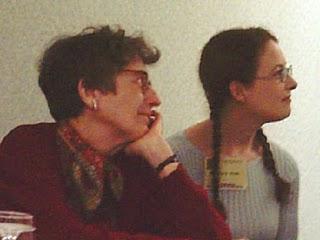
Marilyn Jurich
on the left
Marilyn
Jurich is a poet after my own heart. She is interested
in the bizarre, and she doesn't make much money. Jurich, a
winner of the Ibbetson Street Press Poetry Award, and
a professor at Suffolk University in Boston, has written
about lusty wenches, and rogues in literature, as well as
other characters of this ilk. In 2009 she released a
collection of poems "Defying the Eyechart" ( Mayapple Press)
that deals with her near brush with total blindness, among
other topics. In spite of her condition Jurich continued to
teach and live her life under severe duress. Marilyn is a
scholar/poet and has written about children's literature,
the Jewish experience, Science Fiction, to name just a few
subjects. I talked with her on my Somerville Community
Access TV show " Poet to Poet: Writer to Writer."
Doug
Holder: You had an harrowing
experience with the eye condition Macular Degeneration,that
was the theme of your poetry collection "Defying The Eye
Chart." How has your experience with blindness affected your
poetic vision?
Marilyn
Jurich: First, the poetry collection DEFYING THE EYE
CHART is not really about my own visual disability /
"challenge" as people might say more euphemistically or
favorably. Only the first three poems in the book discover
the condition, and that "discovery" is slant (as Emily
Dickinson might say). I dislike confessional poems -- unless
they are wild like Plath's or recognize something outside of
the eternal self and that pain and misery so associated.
Thus, in "Resisting Blindness" I look at sightless
scorpions, Cyclops who only had a single eye, at how a
landscape painting looks to one visually compromised. I end
this poem with this stanza:
Ghosts
created by imperfect eyes
lift us into others' memory
connecting who we are.
There are
several other poems on eyesight -- one concerned with
madonnas and children in paintings, for in most the Virgin
Mary and Christ child do not look into one another's eyes.
There is a poem about my mother's death and the funeral
director who wanted me to give her eyes "away," another poem
called "Oedipus Visits the Ophthalmologist." And, of course,
having a certain affliction makes you more aware of many
circumstances that you might never have considered.
You ask how my poems, my poetic vision was affected by my
loss of sight (now regained in one eye as a result of
cataract surgery). Well, of course looking at eyes, creating
imagery related to eyes and to vision was a fairly direct
response. Other responses (at least consciously -- may be
more unconscious ones) numerous: I actually saw things with
limited vision I would not have seen before --totally ironic
and rather wonderful; I developed an ear (my hearing always
keen, this not a result of vision loss) for voices --
dramatic monologues; I am a failed musician and transferred
a musical sense to the poems; I felt a keen sympathy for
handicapped people, a need to be angry and strong for them;
the fantasy of sight (especially when I was hemorrhaging)
and the fantastic encounters with those I consulted, both
conventional doctors and atypical healer types, gave me a
new perspective on the world -- total insanity and vast
incompetence. Of course, I was also angry -- that gave me a
strong voice and a courage I never had, INCLUDING the
courage to write poems.
DH: How
did you manage to teach with this disability?
MJ: I
managed to teach classes with little sight and with no
ability to focus or to see faces. (Nor could I make out the
letters on the front of trains and frequently arrived at the
wrong destination.) Well, when I look back at this
"adventure," I don't know how I did it. I think I must have
been crazy. I also feel very smug about this. Not one
student knew that I couldn't really see. I distinguished
students by gesture, by curve of body, by voice (though lots
of students do prefer to remain silent). I graded papers by
an accumulated 1000 watts. I read slowly and painfully,
frequently adjusting the angle of chair, lamp, my own
posture. Hardest, and still hard, are walking down stairs. I
edged along each stair, surreptitiously feeling for a
decline, frequently counted the number of stairs in the
buildings I frequented. Often I felt that I was ignoring
someone in the hall or on the street who may have been
smiling or nodding a "hello." Social contacts were very
difficult. Some still are, as the right side is often too
blurry for me to make out the face I should know.
DH: How
do you feel about the academic world and book biz and how it
promotes, interferes with creating literature, art, and
honest expression?
MJ: Well,
if I were the out-going, well-adjusted, uninhibited,
at-ease, "hail female, well-met," I might think differently.
Since I not the person just described -- nor was I ever even
with "normal eyes -- I cannot self-promote, make contacts,
network, market, push. While I often like to read some of my
poems -- like to dramatize -- I am frequently uncertain of
my own delivery. I am also over-nervous. It all depends on
the group, of course. At the sessions at the International
Association of the Fantastic in the Arts (a member for
umpteen years), I am relaxed. All the others are as zany as
I am -- we share the same interests and we trust one
another. They are interesting in forming meaningful,
well-expressed poems and in sharing ideas and criticism. We
know we are not "getting ahead," filing up credits,
appealing for distinction, awards, position. Also, we are
all basically "poor" -- won't make anything on what we do.
What was absolutely appalling to me was the absence of ANY
response to my collection of poems. It did receive an
honorable mention from the New England Poetry Club; it did
receive a very few nice comments from e-journals. That's it.
No one else commented -- no accolades desired here, just a
"Oh, I really could feel . . ." or "Why did you use-----in
that poem?" or "You know, I think you should have ended that
poem at. . . ." Actually, I wrote to several critics and
urged them to HATE the book. Absence and indifference are
apparently worse for children than cruel parents or parents
who are argumentative with one another. I want a community
of writers / poets who are not solipsistic, narcissistic,
contemplating their next cocktail party in between
contemplating their superlative navels.
DH: In
2005 you got a faculty development grant to study English
chapbooks of the 18th century. Can you tell us a bit about
your study and the history of the "chapbook."
MJ: True
to my tendency of being interested in all things bizarre and
unremunerative, I am infatuated by chapbooks (which, by the
way, exist all over the world and are kept in archives). My
answer will have to be abbreviated here. Chapbooks have a
very long history; these are unbound books on a variety of
subjects both factual and fictional, prose and poetry. They
were carried in packs on the backs of chapmen. (Chap comes
from ceop, middle-English for "cheap.") Costing several
pence, they were affordable by the lower classes who could
also understand the plain-spoken words and the subject
matter. Of course, since literacy was limited, many had to
be recited by several in the village who had the skill of
reading. In fact, it is widely thought that the very
existence of chapbooks led to literacy. Also, many of the
stories told of small men who "made good"; in this sense,
the chapbook encouraged a spirit of advancement, praised
effort and ambition over class privilege and aristocracy.
The books are often humorous, satirical, sexy; chapbooks
also preserved all the old fairytales and myths -- are
considered the first form of children's literature. They
also reprinted versions of Defoe and Swift, works of Tom
Paine, as well as take-offs on Shakespeare. While
conventionally, such materials are printed as 8 page sheets,
there are chapbooks that exceed 100 pages (as The Life of
Mahamet ). Especially interesting for me are the rogue
tales, the depiction of other cultures through some of the
travel adventures, the strong images of women who are
capable and speak their MINDS.
I have collected what I consider the best of these materials
(though frustrated by the many more that I know must exist);
I need to write a book, but what will happen to the POEM???
If anyone is interested in doing such investigatory work in
this field, let me know. And there is also the 17th century
English chapbook and the American chapbooks of the 19th
century!
DH: I
know you have a new collection planned. What are we in store
for?
MJ: I'm a
little superstitious here and that mums me; but I am also
uncertain about what I am doing. I have several long poems I
may want to include. I'd really like to write a verse drama
for the book. I also have children's poems and some more to
write. I used to write a lot of funny poems and want to gain
or regain this facility. Also, there is the "personal life"
and how this can / will fit in. All this in the stage of
unknowing -- and sometimes thinking about writing a poem in
a world that is unworlding or at least stumbling in that
direction seems pointless and conceited. I need someone to
tell me "It's okay."
Reading the
Eye Chart
by Marilyn Jurich
Trick the
gullible eye --
Lines stick out their tongues, diagonals curve.
Vipers hiss from Druid stones under a white sky.
Advancing shadows dance or die,
trick the gullible eye --
embracing fitful ghosts, longing to tie
circle-line to sense before they swerve,
trick the gullible eye.
Lines stick out their tongues, diagonals curve.
This is the alphabet of ferns
singing between the passages of wind.
Dream language of the lover who yearns
for echoing syllable as he gently turns.
This is the alphabet of ferns.
Whoever learns to see one code, design… listen and
rescind.
This is the alphabet of ferns
singing between the passages of wind.
Unraveling my soul by what I see
you count how close I come to hold desire,
gauge my level of normality
according to whether I call the shrinking letter E,
unraveling my soul by what I see,
convinced the eye uncovers mystery --
omphalos to everything we can aspire.
Unraveling my soul by what I see,
you count how close I come to hold desire
Posted by Doug at 7:57 AM 0 comments
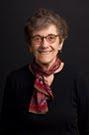
Marilyn Jurich
Associate Professor
English Department
Suffolk University |
 |
Recent
Publications (Selected)
Defying The Eye Chart, A Collection of Poems.
Mayapple Press, 2007 (forthcoming).
“Poetry for Children,” essay in The Encyclopedia of
Children’s Literature, Oxford UP, 2006.
“The Mindless Body and the Bodiless Mind: Gyrations of Body,
Mind, and Soul in Short Story Fantasies by Jewish
Writers” in Fantastic Odysseys. Ed.Mary Pharr,
Prager Press, 2003.
“Children Stranded Among The Dark Satanic Mills” in Journal
of the Fantastic in The Arts, Vol. 13, No. 5, 2003.
“MindingThe Trickster” and “Twenty-two to Trick on the
Tongue,” two poems in Trickster’s Way, an
on-line journal published by Trinity University, San
Antonio, Texas, 2003.
“The Immutable,” “Lines Attributed to King Alfred the Great
(849-899) from Recently Discovered Scrools. . . ,“ and
“Quotients,” poems anthologized in Do Not Give Me
Things Unbroken. Ed. Laura Hechtman Ayers, et.
al,Writers Club Press, 2002.
“Seeing the Eye in the Darkness of Being. . .” (essay with
poems and memoir) in Trickster’s Way, an
on-line journal published by Trinity University, San
Antonio, Texas, 2002.
“Why the Sphinx,” “Threat,” “Reading the Eye Chart,”
“Tachyonic Toss #1,” “The Seamstress of Flowers”: poems
anthologized in Uncommonplaces. Eds. Kerman
and Riggs, Mayapple Press, 2000.
Scheherazade’s Sisters: Trickster Heroines and Their Stories
in World Literature, Greenwood Press, 1998.
“The Pseudo-Cosmographies of Stanislaw Lem” in Utopian
Studies 9. No. 2, 1998.
“Solus Solo, The Monster Self: Solipsism in Peer Gynt,
Grendel, Perfume” in PARA*DOXA: STUDIES IN WORLD
LITERATURE GENRES, Vol. 2, No. 1, 1996.
Selected Publications, 1995-1969
“A Woman’s A Two-Faced” in Journal of Fantasy in the
Arts, Spring Issue, 1995.
“Mithraic Aspects of Merlin in Mary Stewart’s The Crystal
Cave” in Contributions to the Study of Science Fiction
and Fantasy, Marshall Tymn, Ed., Greenwood Press,
1991.
“The Applauded Jigsaw, Patterns of Lives Contoured by
Voices: The Literary Lives of James Playsted Wood” in The
Voice of the Narrator in Children’s Literature: Insights
from Writers and Critics. Eds. Otten and Schmidt,
Greenwood Press, 1989.
“A Critical Exploration of the Aborigine in Australian Books
for Children” in Webs and Wardrobes: Humanist and
Religious World Views in Children’s Literature,
Eds., Milner and Milner, University Press of America, 1987.
“Children;s Literature in the College Classroom,”
College English, February, 1983.
Coordinating Editor, The Unforbidden Fruit: A Journal
in Fantasy and Folklore, Suffolk University, 1977.
“What’s Left Out of Biography for Children” in The
Great Excluded: Critical Essays in Children’s Literature,
Vol l, No, 1, Yale UP, 1972.
A Department Store Has Everything! and Seeds from the
Store, A Play and Poems for Children. Boston: Todd
Press, 1969.
Courses Taught:
Advertise with
the Boston Area Small Press and Poetry Scene!
http://tinyurl.com/ddjcal
Boston Area Small Press and Poetry Scene
http://dougholder.blogspot.com
ISCS PRESS
http://www.iscspress.com
Doug Holder's
CV:
http://dougholderresume.blogspot.com
Ibbetson
Street Press
http://ibbetsonpress.com
Ibbetson Street
Press Online Bookstore
http://www.lulu.com/ibbetsonpress

