
Breindel
Lieba Kasher, IL
|
Free
Verse
The
Survivor
Barbed wire
Smoke and fire
Nothing comes close
He said
Come close
No one can know
There are
No words
Hanging
the Wash
Hanging the wash, the water
is hard
A fiery wind whips
across my face
Clothes blow stiff, color drenched.
In slow motion, a black scorpion
Lifts her tail like a Japanese dancer
Father
Wrapped up in white
Sticks and bones
Flesh of my flesh,
Don’t leave me
Your trembling bamboo branches
Her Alone
ness
Her alone ness
Was endless
Silence filling spaces
Resting on every surface,
Invisible and deadly……
I See
Your Face
I see your face
It rolls in
On the hush of night
Through the holes in the screen
Your last breathes
Vapors of death
Your eyes keep watching
With no time remaining
Another
Bomb
Another bomb,
Another bus
Blood runs
On rainy streets
The Chevra Kadisha
Pick up
With plastic gloves
Into plastic bags
Limb by limb
Skin and bone
Ambulances hurry away
Hurry away
June 2003
Gas
Masks
Time to check
Your gas masks
The notice
Came in the mail,
Like it was normal
Or something!
January 2003
Jedwabne*
A wooden barn once
stood in this empty space.
Before the barn door opened,
Before the Jews were forced inside,
Before the door locked, before the kerosene,
Before the match, before the fire,
Jews and Poles of Jedwabne lived side by side.
In this valley of destruction,
I hear the echo of my people.
The boarders of time are fading.
Rain falls off and on.
The Polish president welcomes the delegation,
Huddling under umbrellas, blowing.
I am part ghost, a Jewish woman, returning.
What are they thinking, the people of Jedwabne,
Standing behind the barricade.
It was here in the old market
The Poles were waiting,
With axes and clubs, raping,
Jewish mothers and daughters drowning,
In a river of blood overflowing.
In their eyes I am searching,
But they have no answers to give me.
Some look back at me,
Some look down, some are laughing.
Some were killers,
Others peeked out behind curtains,
Everyone heard the screaming,
Church bells are ringing.
Sixty years ago today, on July 10, l941,
The Polish half of Jedwabne,
Murdered its other half, the Jews.
1,600 Jewish men, women, and children,
Killed in one day.
Antonia Wyrzykowska, a Polish woman
Who lived outside of town,
Hid seven Jews.
We are walking in silence
To the site of the old barn.
These hills, so open, protected no one.
I wish I had someone to hold on to.
A wooden barn once stood in this empty space.
Before the barn door opened,
Before the Jews were forced inside,
Before the door locked, before the kerosene,
Before the match, before the fire,
Jews and Poles of Jedwabne lived side by side.
Rabbi, Jacob Baker is speaking.
His family ran the flourmill.
Born in Jedwabne,
He learned in the great Lomza Yeshiva,
And left for America,
A year before the war.
"The spirit of the Jews is still here," he says.
"On this very holy ground,
The people of Jedwabne should pray,
And beg forgiveness,"
We say Kaddish. We light candles.
"Let’s go drink hot tea," she says,
"That will warm us."
She, who they call a Pole of Jewish origin,
Discovered her Jewish ness
During the purges of 68’.
"Don’t worry," she says, "it’s safe."
We walk to the local café.
I am uneasy,
Two women in a place like this,
Packed with men, drinking.
An old man, with his finger,
Signals us to join him.
Behind a long wooden bench,
We slide in.
"Where are you from," he asks?
"From Warsaw,"
"And her," pointing to me?
"She’s from Israel."
"Israel? A Jude,"
He says, slow and evil
"Du bist a Jude?
Heil Hitler, Jude!"
Everyone is laughing.
What should I do?
I have no idea.
I have no fear, but I am shaking.
I stand up, with the hot tea in my hand.
Can I throw it in his face? I cannot.
I walk out the door,
Into Jedwabne’s putrid air.
"He was drunk," she says.
"He didn’t know what he was saying."
"He is old," I say.
"He was there.
He knows everything."
We are walking, back to the bus.
I have stepped out of my body.
Polish flags are waving.
Coming towards us,
A group of men, shouting,
"Poland for Polish People!"
"We came to show solidarity
With the People of Jedwabne."
They are glad
There are no more Jews here.
Antonia Wyrzykowska saved seven Jews.
After the war,
When the people discovered her righteousness,
They drove her out of Jedwabne,
Out of Poland. She settled in Chicago.
Returning to Krakow,
I need to wash the day off.
I want to sleep,
But sleep does not come.
I remember some lines from a poem,
Elgy, by Antoni Slonimski:
"No more, no more
Jewish townships in Poland
They sprinkled sand over the blood,
Swept away the footprints
White washed the walls with bluish lime,
Like after a plague
They are no more, these townships,
They passed like a shadow…………"
July 10, 2001
*On July 10, 1941
during World War II in German Nazi occupied Poland, the mass
murder of hundreds of Jewish residents of Jedwabne took place.
The Polish Institute of National Remembrance investigation
confirmed that approximately 40 non-Jewish ethnic Polich men
from around the town of Jedwabne participated in the mass
murder.
About
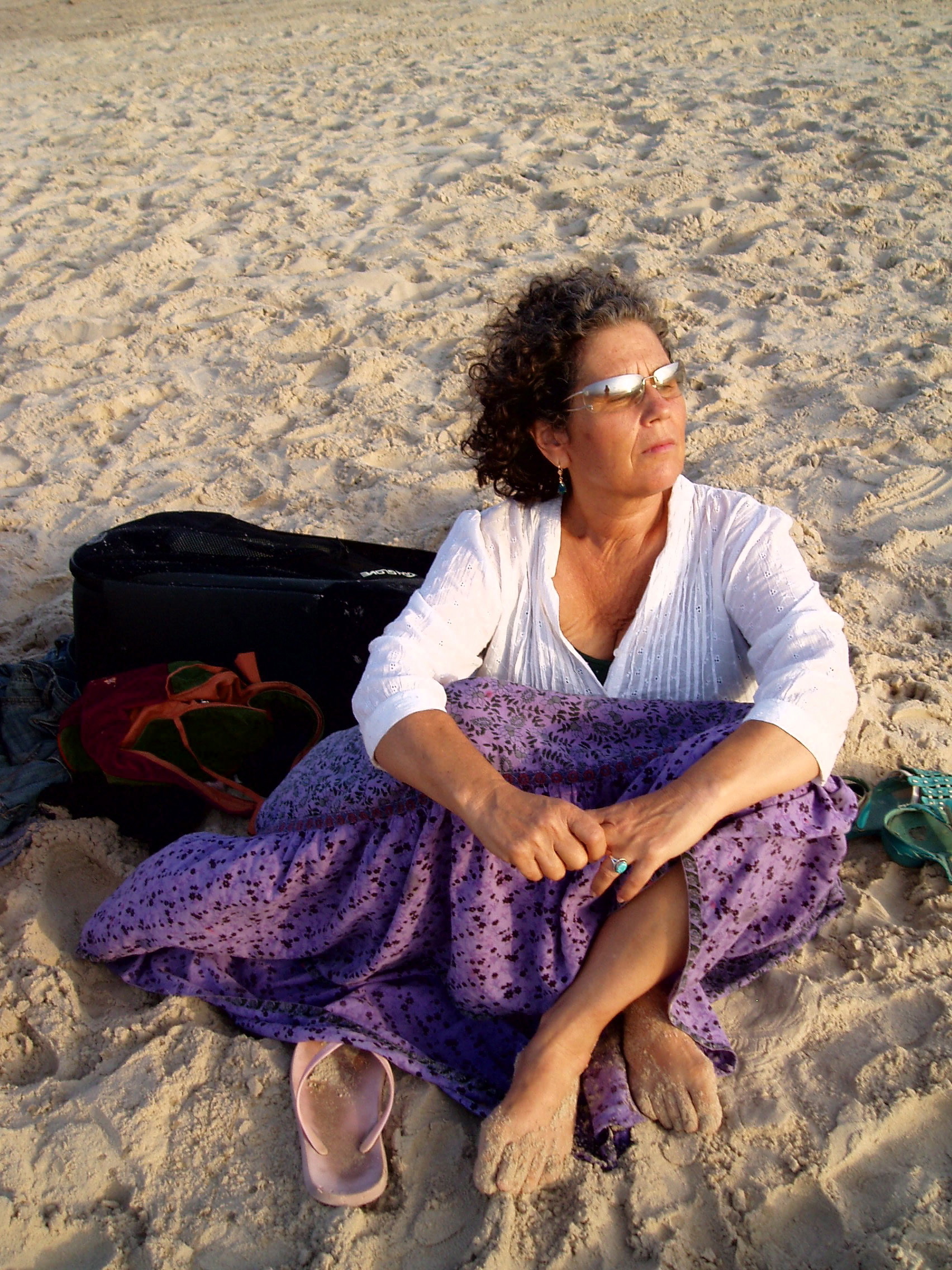
Breindel Lieba Kasher
I am a poet, writing my
whole life, published in many different books and
magazines.
Born in New York City, I was a child of the sixties,
during a time of art and anarchy.
I moved to Israel, half a life ago, and raised four
children in the country.
I traveled throughout Eastern Europe, filming and
documenting the last remnants of Jewish life. From my
travels, I made a documentary film in Yiddish with English
subtitles entitled, "Der Letzter Lubliner," (The
Last Jew From Lublin.) The film is shown all over the
world, and taken up by Boston's Facing History,
teaching the legacy of the holocaust inAmerican schools.
I wrote three books: Oral Torah from the Warsaw
Ghetto, Who Robbed The Moon, and Wandering Stars.

|
|