Sally Evans, UK
Tea Gowns or
Shawls?
The local undertaker
runs our rural auction. This is not uncommon in Scotland. It
presumably goes back to the days of grave robbing, and
legimitised selling the effects of the dear departed. However
there are many sources of goods in the auction, including the
big city auctions who slip goods into the country sales if they
don't make their fancy town prices.
The auction is right out in the country, off the beaten track
(but conveniently near a motorway). The tiny village (a few
houses looking over the River Allen) used to serve a wartime
bakelite factory but its entire conversation nowadays is about
farming. There is not enough space for parking on auction days,
and the narrow road is partly blocked by cars. A lady from the
nearby farm deliberately charges through with a horse box in mid
sale, which sometimes comes to an abrupt halt while half the
bidders have to go out and move their cars to let her through.
We have bought everything from a chimney pot (for the garden) to
a rowing boat there. You can just walk round the house and see
things—my
marionettes with their theatre, pictures, furniture, rugs—I
don't think there's a thing in the house we've bought new.
A country auction is a slow business and there's a routine to
it. Its a bit like sitting in a church service with the familiar
phrases to listen to week by week—the
auctioneer asking for absolute silence, threatening to fine
people £5 for the local hospice if their mobile phones go off,
and reminding everyone to wait for a porter to collect their
goods.
As the sale progresses he becomes less formal, unable to resist
the most ludicrous anti-feminist jokes: "buy this folding bed if
you don't want your mother in law to come back"—holding
up an axe and a shovel and saying "Its cheaper than a divorce,
guys." "Awful looking damn thing, but you ken who you can give
it to for Christmas." Sometimes new people look offended, but
his charitable regulars smile.
While you are waiting between lots you want to bid for, you can
go outside to the burger and stovies wagon, and listen to the
gossip over a beaker of coffee. You can sometimes buy a few
garden plants from the cook—I
got my beautiful Cannas there last year. I've tried to
over-winter them but I will probably have to buy new ones again
this year. They can't stand the frost.
The winter is over (we hope, but we cannot be sure—the
heaviest snowfall in recent years came in mid march.) Small
spring flowers are blooming and Easter is not too far away, when
Glaswegians traditionally come to Callander for a day out and
the kids roll their painted hard-boiled eggs down the local
slopes. The slopes near the river are an unbelievable mess of
eggshell afterwards. Easter is more important than Christmas to
our rural community—it
heralds the start of the tourist season.
Unable to get out in the garden too much in winter, because of
the darkness, I joined an internet garden chat group (very
British?) where the ladies spent much time discussing their
dogs, especially a deaf rescue Boxer puppy one of them had taken
on. There was also good stuff about gardening, and I found two
horticultural ladies in Aberdeenshire, over on our east coast.
The manager of the site gave me this avatar, as he realised I
was a poet.
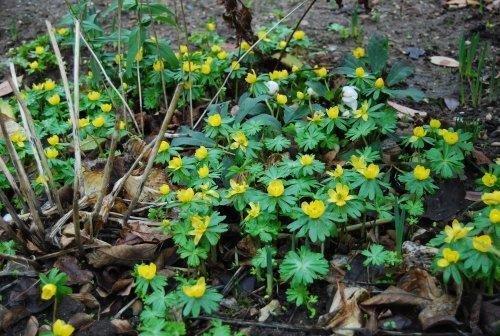
One of the ladies on the site sent me a pic of her aconites,
with permission to use it. I am a mug about these little yellow
flowers. I remember sheets of them when I was a child, and have
spent much of my gardening life trying to replicate them, but as
they are very slow to establish, and you can lose headway in a
bad year, I am still struggling. I started a group called
'Winter Aconite Bores' on a well known web community site,
saying that it would be dormant over the summer months. I was
able to link with American musician Frances White, who wrote
Winter Aconite Music. But I didn't actually find another aconite
bore.
It's a good time of
year when the days are getting lighter, as anyone who lives at
our distance from the equator will know. Our son came out from
the city, hoping to see the lunar eclipse away from the
artificial light, but nothing was to be seen through the mist
and rain. He likes to be PC and cycle around the country, but he
got lost in the dark and rain and phoned us to ask us where he
was. Of course we didn't know. In the end I went out looking for
him, found him six miles up an iron age hill track, put his bike
in the car and brought him back. Hope he doesn't read this.
I'm off back to the auction now, hoping nobody else has noticed
Lot 341, stashed under a table. Beneath the inevitable junk are
some very old Shetland shawls, possibly even a St Kilda one. But
what I really like is on view for all, a green 1911 tea gown.
All I can say is I probably won't be coming back empty handed.
Sally Evans