|
Report from Callander
Central
Scotland February 2007
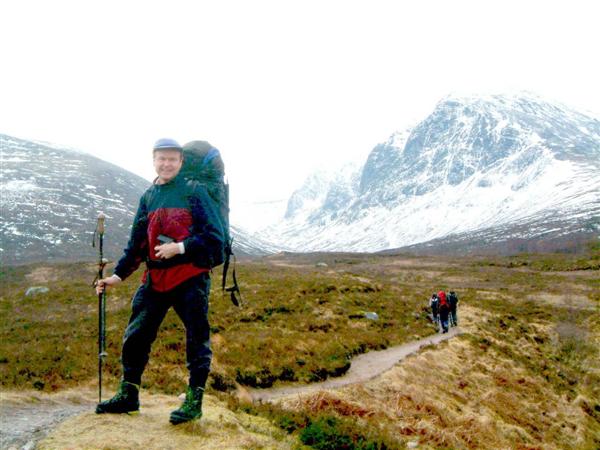
Here are the highlands in
winter, a dusting of snow, intrepid walkers and climbers.
Towns such as Callander are down in the valleys among the
hills. On Ben Lomond, not many miles away. (Photo: Stephen
Evans) |
This is an old
town. The land behind the houses was at one time owned in strips
which ran from the forest right down to the river. Everyone had
a toehold in the forestry and fishing. Over the centuries land
parcels have become very complicated. It is often difficult to
be certain where the gardens divide. Certainly no-one this
(upper) side of the main road has fishing rights along with
their properties, these days. Fishing still goes on. Though many
stretches of the river are posh and private, day permits can
easily be acquired for a central portion of the river, where in
any case toddlers still pester minnows and tadpoles on a regular
basis, kiddies' fishing nets for the purpose being easily
available in local stores. And the whereabouts of the water
bailiffs being often surmisable, and light running from 3 am. to
11 pm. in summer (British Summer Time is one hour ahead of
Greenwich) there is a fair amount of personal poaching, no
doubt. It is when people poach to sell on to hotels that the law
gets serious.
The fish in the river include trout, salmon, and carp. It is not
as well stocked as it used to be: it is said the river used to
"boil" with leaping fish on a summer evening. Fishing, road
salt, otters, mink—various factors have reduced their numbers.
Road salt is a serious problem, because not properly recognised.
Tons of salt are poured onto the roads each winter, to make them
safer from ice, but the salt gets into the freshwater and
undoubtedly affects species such as salmon, mussels etc.
On the forest side of the road, you can help yourself to a
certain amount of firewood, as there is more than enough there
rotting, though this right is much more debatable now that the
whole area is part of the new National Park. Garden ground is
quite generous, and in places unkempt as some of it is owned by
people too old to do much about it—and we all see age coming our
way in the long run. Hedges can run to six feet in width—and on
whose land? Usually the one next door to whoever planted the
hedge! We are taking down a massive privet hedge because it
needs so much pruning in summer, and it has taken us two years
so far to get half of it down.
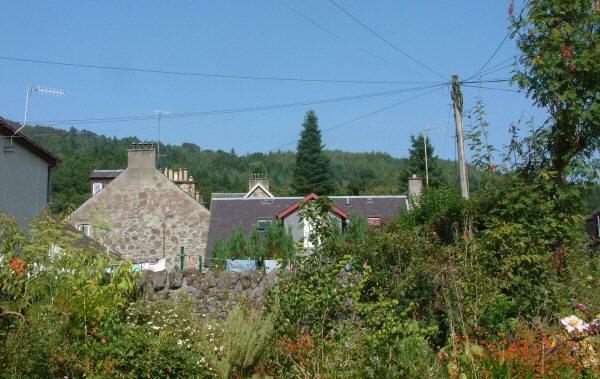
Behind the houses, a jumble
of gardens, with a telephone pole in the six-foot thick
hedge, sending wires to the houses around. Wooded crags
form the backdrop, the main road then the river behind us.
Oh for a summer day like this. (Photo: Gerald England) |
To the delight of a neighbour we have planted a bay tree on his
land, and a huge bag of daffodil bulbs planted three years ago
have produced a communal daffodil border.
Snowdrops were absent from this ground when we came, but those I
have planted are spreading firmly, the singles at least.
Unfortunately, slugs go for the doubles and the wide-leaved
varieties. The same goes for winter aconites, which I have
struggled to introduce (and I am only undefeated because I have
gone on trying, as the poet says).
One of our most interesting indigenous plants is the Glencoe
Rose. Glencoe, the rocky hillside with the dreadful history and
the dreadful road, is not far from here. Up there one day we had
parked and found a beautiful burn just out of popular reach, as
you do, and there was an old, old wild rose bush with its roots
torn out of the rock by floods. I took cuttings by way of
rescuing it, and after a couple of years looking moribund in
pots, they have come away, and produced a very beautiful, very
red wild rose . Each flower lasts only a day, and the whole bush
flowering period is only a week or two. Our theory is that it
was never seen in flower by the plant collectors of the
eighteenth and early nineteenth centuries (Sowerby and co).
Sowerby worked from London and relied on "amiable and
accomplished misses" and country clergymen to send him specimens
from as far afield as Scotland. And the rose was English. Who
wanted to find special roses in North Britain? Anyway that's our
theory, and the flower has stumped botanists we have shown it
to.
Which rose was Robert Burns writing of when he said, "My love is
like a red, red rose?" Not a modern florist's rose, that's
certain. My colleague Colin Will, poet and botanical librarian,
was asked this question by the philatelic bureau when they were
designing a commemorative stamp for Burns. He pointed them in
the direction of a deep-coloured wild rose, rather similar to
ours, and in due course it appeared on the stamps.
Writers from the surrounding countryside meet weekly at Stirling
Writers, usually in the town's flagship theatre (which has its
problems including ghosts). After the sessions, we adjourn to
the even more historic pub, the Portculllis, at Castle height
above the city, and go over our business like councillors after
a meeting. Twice this winter the writers came to Callander,
while the usual venue was being repainted (and, as I suggested,
possibly exorcised). Indoors, in dark, in winter. We had our
only snowfall during one of these meetings, and an intrepid
writer had to cycle back over the mountains in the snow. He
survived to say it was a very beautiful ride.
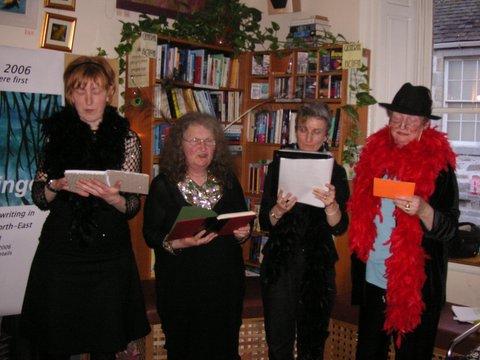
Whiling away the winter – a
group of writers in a bookshop in Aberdeen last spring. We
called ourselves the "Word birds" and gave a good
performance. Sally Evans is second left. (Photo: Judy
Taylor) |
We have a good range of work at the Writers Group, including
novel chapters, plays, and poems, by some pretty clever guys and
gals. They have a good tradition and a good publishing record.
We started going there a year ago, and we never miss it if we
can help it.
Mid February—another winter over. From now we look forward to
the solstice in a few quick weeks' time, and the summer light.
|

