|
Janus
by Micha F. Lindemans
Janus is the Roman god of gates
and doors (ianua), beginnings and endings, and hence represented
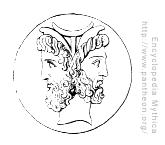
with a double-faced head, each looking in opposite directions.
He was worshipped at the beginning of the harvest time,
planting, marriage, birth, and other types of beginnings,
especially the beginnings of important events in a person's
life. Janus also represents the transition between primitive
life and civilization, between the countryside and the city,
peace and war, and the growing-up of young people.
Janus
One tradition states that he came from Thessaly and that he was
welcomed by Camese in Latium, where they shared a kingdom. They
married and had several children, among which the river god
Tiberinus (after whom the river Tiber is named). When his wife
died, Janus became the sole ruler of Latium. He sheltered Saturn
when he was fleeing from Jupiter. Janus, as the first king of
Latium, brought the people a time of peace and welfare; the
Golden Age. He introduced money, cultivation of the fields, and
the laws. After his death he was deified and became the
protector of Rome. When Romulus and his associates stole the
Sabine Virgins, the Sabines attacked the city. The daughter of
one of the guards on the Capitolian Hill betrayed her fellow
countrymen and guided the enemy into the city. They attempted to
climb the hill but Janus made a hot spring erupt from the
ground, and the would-be attackers fled from the city. Ever
since, the gates of his temple were kept open in times of war so
the god would be ready to intervene when necessary. In times of
peace the gates were closed.
His most famous sanctuary was a portal on the Forum Romanum
through which the Roman legionaries went to war. He also had a
temple on the Forum Olitorium, and in the first century another
temple was built on the Forum of Nerva. This one had four
portals, called Janus Quadrifons. When Rome became a republic,
only one of the royal functions survived, namely that of rex
sacrorum or rex sacrificulus. His priests regularly sacrificed
to him. The month of January (the eleventh Roman month) is named
after him.
Janus was represented with two faces, originally one face was
bearded while the other was not (probably a symbol of the sun
and the moon). Later both faces were bearded. In his right hand
he holds a key. The double-faced head appears on many Roman
coins, and around the 2nd century BCE even with four faces.
Article details:
* Also known as:
Bifrons
* Pronunciation:
jayn'-uhs
The god of gates and doors,
beginnings and endings. (Coin)
Janus." Encyclopedia Mythica. 2007.
Encyclopedia Mythica Online.
25 Jan. 2007
|


