|
KARINA: When did you first
become interested in the arts?
F. N. WRIGHT: I began "doodling" very young as I think
most children did/do.
As far as painting goes I would guess about the age of 21. As to
what influenced me?
That is hard to say. There are a lot of artists in my family, as
my Mother was but am not certain the influence came from there.
My interest in photography began with my first grade teacher. I
wonder how many first grade teachers taught their students
anything about photography; the ability to take multiple images
on one frame? The sky at night WAS my first exposure to this new
world. If memory serves me right her name was Edna Windau.
KARINA: Could you explain what it was like to be an artist and grow up
in the sixties –an era of war, politics, passion, drugs and
music. I know you are a poet as well, and both of the arts are
interacted in your work.
F. N. WRIGHT: Needless to say it was an exciting era for those
of us who experienced it. I think the sad thing was the Vietnam
War was always there: Basically from 1959-1975. And when it
ended disco music came into vogue. A sad ending to a time when
Rock musicians were discovering and exploring new concepts &
inventing new variations on the world of music. Ironically
beginning with the so called British Invasion on the American
Rock scene. I say ironic because it was their discovery of
American blues musicians and songs buried deep in American music
history that led to this" new sound".
I was somewhat of an enigma in one way in that I sometimes joke
among friends "That I am one of a handful that can say they
survived both The Vietnam War and the "Summer Of Love" in San
Francisco". The only way I survived the latter was by learning
early and the hard way not to tell anyone I was a Vietnam
Veteran. This was not easy to do because I was proud of having
served in Vietnam and still am.
I mention music because I was primarily a prose writer even
though I had discovered the "beat" poets in the 50's and was
listening to more jazz and folk music than I had in the past. I
hung out in North Beach and Venice Beach when I could but there
was also a heavy "beat" influence in San Diego.
When I was not overseas I was stationed at The Coronado Naval
Amphibious Base and the "beats" did not turn away or put down
service members as the "hippies" would later do. My art at the
time was also very bland in that I hadn't found the right muse
yet; and here I return to music. I discovered Dylan, Ken Nordine
and Gil Scott-Heron (both with and without The Last Poets) and
others. I was hearing the cadence of the street and that led to
my interest in poetry though I continued to write mostly prose I
was writing more and more poetry and would publish poetry before
anything else of mine was published.
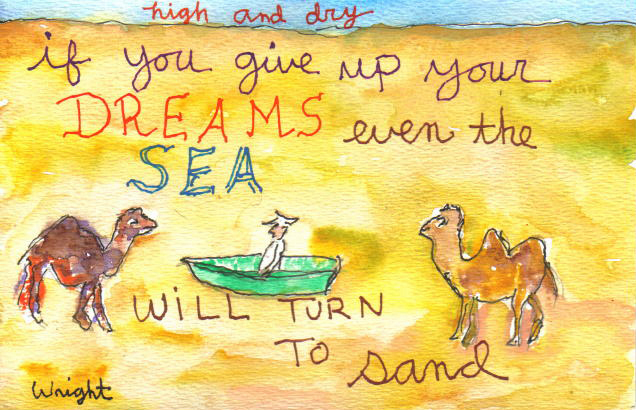
Sometime in the early 60's I began combining poetry with art.
"Psychedelic" art (mostly in the way of posters and handbills)
caught my eye and a friend (after seeing what I was doing)
turned me onto Kenneth Patchen. It was encouraging to find
someone else was doing something similar to my attempts but
doing it a helluva lot better than me; I eventually began
corresponding with the Patchens and this would lead to a
lifetime friendship with Miriam after Kenneth passed away not
long after we were corresponding. That became all the
encouragement I needed to continue and avidly seek out and study
other painters. By the time I hit my own stride I found it was
color and sometimes texture that intrigued me most.
I did some experimenting with drugs and found LSD, peyote and
"magic schrooms" brightened colors but I never tried painting
while "tripping". Of those three drugs LSD was my least
favorite. I might add the first painting with poem I sold was of
a soldier, sitting on a rock. His rifle leaning against the rock
beside him and his elbows resting on his knees with his face
buried in his face hiding the anguish he felt. His helmet had
dropped to the ground at his feet. The poem was titled: "War".
As you can probably guess, it was a bittersweet period in my
life but one I am glad I experienced and survived.
KARINA: At a very early age you learned to look at the
world around you in a subjective way. Surrounded by realism and
impressionism during the decades to come, you must have
internalized your own view point, maybe creating your own inner
world of color and fantasy.
KARINA: Can you tell me more about the inspiration behind your art?
F. N. WRIGHT: More about the inspiration behind my art? That's
hard to pin down. I would have to think my reading was a major
influence. I was reading before school and have been a prolific
reader my entire life. Reading of course aroused my curiosity. I
grew up in a small town in Southern Illinois (Mattoon to be
exact). I was bored and felt I was no longer learning anything
"new" in school. My parents never understood why they would
first look at the public library when they received a call from
school that I was not in attendance. They didn't understand I
felt the books I was reading "taught" me more than high school
text books. My escape was quitting school and enlisting in the
Navy when I was seventeen. There were no wars going on and it
was a chance for me "to see the world." So I not only traveled a
lot across the different landscapes that America offers (which
surely has to be an inspiration to any artist) I was able to see
many foreign countries. I was also still heavily into
photography and often carried two 35 MM cameras; one with color
film and one with B & W. I became certified as a scuba diver and
took many underwater pictures; and learned to develop and
manipulate (transform the images) of B & W negatives during the
film processing. I had started writing at age of ten (inspired
by baseball of all things) and am sure the "worlds I created
with words" was a large inspiration on my painting since I had
to mentally visualize these "worlds of mine." I should add there
were no "wars" taking place I knew of upon enlistment which
would lead to my involvement in both "The Quemoy-Matsu Islands
Crisis" and Vietnam.
KARINA: You are an Icon of this time, a survivor of turmoil in one of the
most difficult times in our history.
F. N. WRIGHT: I am uncomfortable with being
called an Icon. A "relic" might be more appropriate. (laughs).
And I would like to thank you for being interested enough in
what I do to interview me.
|